
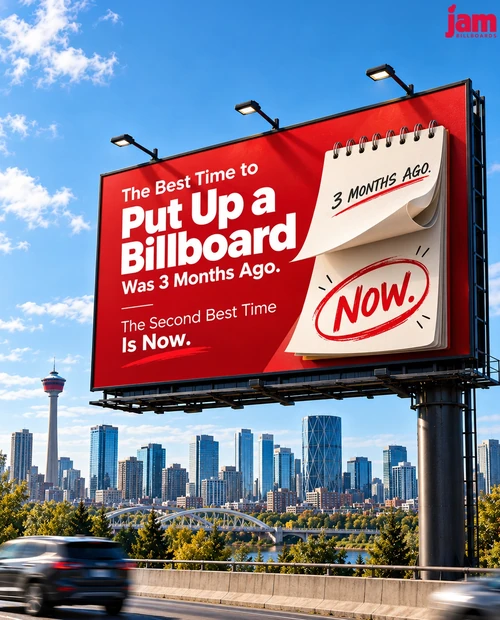
The Best Time to Put Up a Billboard Was 3 Months Ago. The Second Best Time Is Now.
"We'll advertise once things pick up."
We hear it constantly — and it's backwards. Here's why timing your billboard around your busy season usually means starting earlier than feels natural, and why waiting is the most expensive choice of all.
Awareness runs ahead of revenue
Billboards work through repetition: Day 1 they notice you, Day 3 they recognize you, Day 10 they remember you. Then — days or weeks later — they need what you sell, and your name surfaces.
That lag is the whole point. It also means:
- A landscaper shouldn't launch in June. Launch in March, when homeowners start planning.
- An HVAC company wants furnaces on minds in September, not during the January cold snap when everyone's already picked someone.
- A restaurant near the Stampede Grounds wants weeks of familiarity built before the crowds arrive — our Crossroads board sits on one of the main routes to the Stampede Grounds, Saddledome, and BMO Centre, with 1,750+ events happening in the area annually.
Work backwards: when do customers decide? Be on the road 4–8 weeks before that.
The counterintuitive case for slow seasons
Advertising in your off-season feels wasteful. It's often the smartest money you'll spend:
- You're building for the next peak while competitors go quiet.
- Share of voice is cheaper when fewer businesses are shouting.
- Consistency compounds. The business that's visible year-round owns the category in customers' heads. The one that pops up for six weeks and vanishes starts from zero every time.
There's a reason the biggest brands never stop advertising — even though everyone already knows them. Especially because everyone already knows them.
What waiting actually costs
Every month you wait, 35,000+ vehicles a day pass a board that doesn't have your name on it — over a million impressions a month going to whoever did book the spot. Digital billboard inventory is finite: 10 advertisers per screen, and when it's full, it's full.
The honest takeaway
There's no perfect moment. There's just the buying cycle you want to be ahead of, and inventory that's available today but maybe not next quarter.
Spread the word before you need it heard.
Check availability at jambillboards.com — let's find your window.

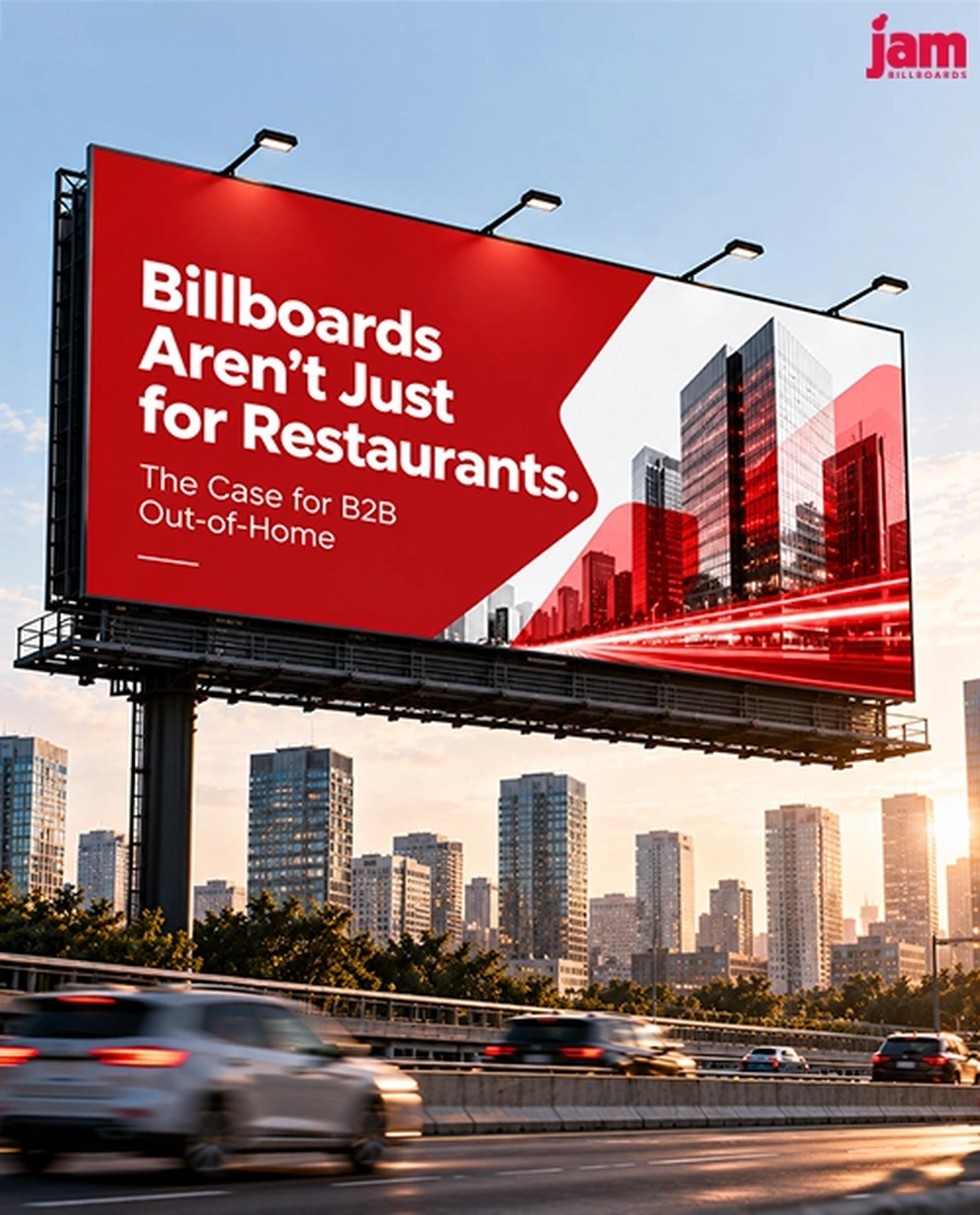
Billboards Aren't Just for Restaurants: The Case for B2B Out-of-Home
Quick word association: "billboard advertising." You pictured a burger, a car dealer, or a personal injury lawyer, didn't you?
Here's what almost nobody pictures: an equipment rental company. An industrial supplier. A commercial HVAC outfit. And that's exactly why B2B billboard advertising in Calgary is such an underpriced opportunity.
Decision-makers drive too
B2B marketers obsess over LinkedIn and trade shows while ignoring a simple fact: the owner of that 40-person construction company spends more time in a truck than on LinkedIn.
Our Foothills Industrial board at 7460 52nd Street SE sits in the engine room of Calgary's economy — surrounded by over a thousand businesses, with 35,000+ vehicles passing daily. The audience isn't random: it's work trucks, fleet vehicles, logistics drivers, and business owners moving between job sites, suppliers, and warehouses. 65% of that traffic is decision-makers. This makes the location a strong choice for outdoor advertising in Calgary.
Try buying that audience on any digital platform. You can't — not without paying B2B ad rates that make your eyes water.
Why B2B and billboards fit so well
Long sales cycles need long visibility. B2B buyers don't purchase on impulse; they buy when a contract comes up, a supplier fails, or a machine breaks. A billboard keeps you top of mind for months so you're the first call when that day comes. That's where a consistent billboard marketing strategy can make a difference.
Trust is the product. B2B deals run on credibility. There's a reason companies still say "as seen on TV" — visible brands feel established. A business bold enough to be on a billboard reads as a business that's doing well. Digital billboard marketing can reinforce that visibility with repeated exposure.
Your competitors aren't there. B2B out-of-home is uncrowded. While everyone fights over the same LinkedIn feed, the road to the industrial park is wide open, creating an opportunity for local billboard advertising.
Who this works for
Equipment rentals. Industrial suppliers. Trades and contractors. Commercial services. Safety and workwear. Fleet services. Recruiters hungry for skilled labour. Basically: anyone who sells to the people who keep this city running.
For these businesses, digital billboard advertising in Calgary can put the brand directly in front of people travelling through key commercial and industrial areas.
The play
One board, one clear message ("Crane rentals. Same-day. YYC."), a run long enough to cover a buying cycle. Then answer the phone when the cycle turns.
Businesses looking to rent a digital billboard in Calgary can use this approach to stay visible throughout the buying cycle.
Want your name on the road every decision-maker in southeast Calgary drives? Get a quote at jambillboards.com and explore your options for billboard advertising in Calgary.

How a Digital Billboard Actually Works (Loops, Spots, and What You're Really Buying)
Most first-time billboard advertisers have never been told how the machine works. Then the invoice terms confuse them — "spots,""loops,""faces" — and confusion kills deals that would've been great fits.
So here's the plain-English version.
The loop
A digital billboard doesn't show one ad all day. It runs a rotating loop. On JAM boards:
- The loop is 1 minute long
- Each advertiser gets a 6-second spot
- A maximum of 10 advertisers share each screen
Your ad appears once every minute, all day, every day. That works out to about 1,440 plays per day — roughly 144 minutes of screen time daily. Every single day of your term.
"Faces" — and why they matter
Our boards are double-sided, so each location has two screens facing opposite directions (East/West at Crossroads, North/South at Foothills). Each side is a "face," priced separately. One face catches traffic going one way; buy both and you own the road in both directions.
Why 6 seconds is enough
Sounds short — until you remember that drivers only look at any billboard for a few seconds anyway. A 6-second spot with a 7-word message gets fully absorbed. Then it comes back around 60 seconds later. And again. Repetition does the heavy lifting, not duration.
What you're really buying
Not a sign. Not pixels. You're buying time, visibility, and frequency in front of a specific daily audience — 35,000+ vehicles per day at each of our locations. And because it's digital:
- No printing costs.
- Creative swaps anytime. New offer? New number? Updated without a crane or a print run.
- You can run different messages by season, promotion, or even A/B test headlines between 4-week periods.
Terms, simply
Billboard campaigns run in 4-week periods, and longer commitments earn better rates — because consistency is what makes billboards work in the first place. (The exact numbers are a quick phone call; we'll walk you through options for your budget live.)
That's it. That's the whole machine. No mystery, no jargon — just a bright screen on a busy road doing its job 1,440 times a day.
Questions about how it'd work for your business? Ask us anything at jambillboards.com.
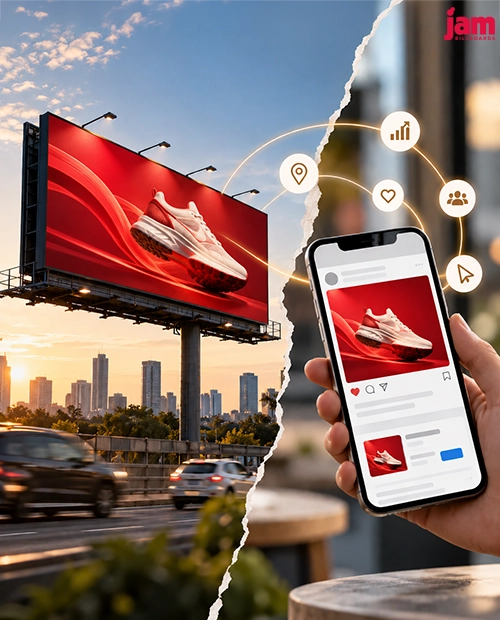
Billboards vs. Digital Ads Is the Wrong Fight. Here's Why They Work Better Together.
Business owners keep asking us: "Should I do billboards or online ads?"
Wrong question. The businesses getting the best results in Calgary aren't choosing — they're stacking.
Why online-only has a ceiling
Digital ads are precise, but they interrupt. People scroll past them, skip them, block them — the average person is bombarded and has learned to tune them out. Worse, an online ad from a business nobody's heard of has to do two jobs at once: introduce you and convert. That's expensive.
Why billboards fix that
Billboards belong to the landscape. No ad-blockers, no skip button, no bidding war. When a Calgarian sees your board every day on their commute, something quiet but powerful happens: you become familiar. And familiar businesses get clicked, called, and trusted.
That's the amplifier effect: the board warms the audience, and your digital captures the action.
What stacking looks like in practice
- Board goes up on a commuter route — 35,000+ vehicles a day start seeing your name.
- They Google you later. Branded searches rise during billboard campaigns; make sure your website and Google Business profile are ready to catch them.
- Your online ads suddenly work harder. A retargeting or search ad from a brand people recognize converts better and often costs less per result — familiarity lifts click-through.
- Social proof loop. Post a photo of your billboard on your socials. Customers love seeing a local business "up in lights," and it stretches the campaign beyond the road.
The 60/40 idea
Many local businesses flip their thinking: instead of 100% of budget into crowded digital channels, they put a portion into becoming known (the board) and the rest into converting the now-warmer audience (search, social, retargeting). Awareness feeds conversion. Conversion without awareness is just renting strangers.
The takeaway
Don't pick a side. Own the street and the screen. That's how local brands stop being invisible.
Ready to add the missing layer to your marketing? Get a quote at jambillboards.com.